

OEM & Private Label Canned Sardines: How to Launch Your Own Canned Seafood Brand
Launching a private label canned seafood brand does not require owning a seafood factory. For importers, wholesalers, supermarket suppliers, food distributors, and emerging food brands, working with an experienced OEM canned sardine manufacturer can reduce manufacturing complexity while allowing you to control the product specification, packaging, brand identity, and target market positioning.
This guide explains how OEM and private label canned sardines work, what buyers should customize, how to evaluate a supplier, and what to prepare before placing a bulk order.
What Is OEM Canned Sardine Manufacturing?
OEM canned sardine manufacturing means that a seafood factory produces canned sardines according to your brand requirements. Instead of purchasing a finished product under the manufacturer's brand, you can develop a product that is sold under your own company or retail brand.
For B2B buyers, the process can cover much more than printing a label. Depending on the supplier and target market, OEM production may include fish specifications, can size, ingredients, sauce or oil formulation, lid type, label design, outer carton packaging, case configuration, documentation, and export logistics.
DINHOLG's canned seafood operation supports OEM and private label customization for international buyers, including customized can labels, outer cartons, sauce proportions, and packaging specifications. Its canned sardine products are positioned for supermarkets, wholesalers, catering businesses, food distributors, and private label brands.
For buyers starting with sardines, reviewing the available canned sardine range is a practical first step because it shows the current product format and wholesale positioning.
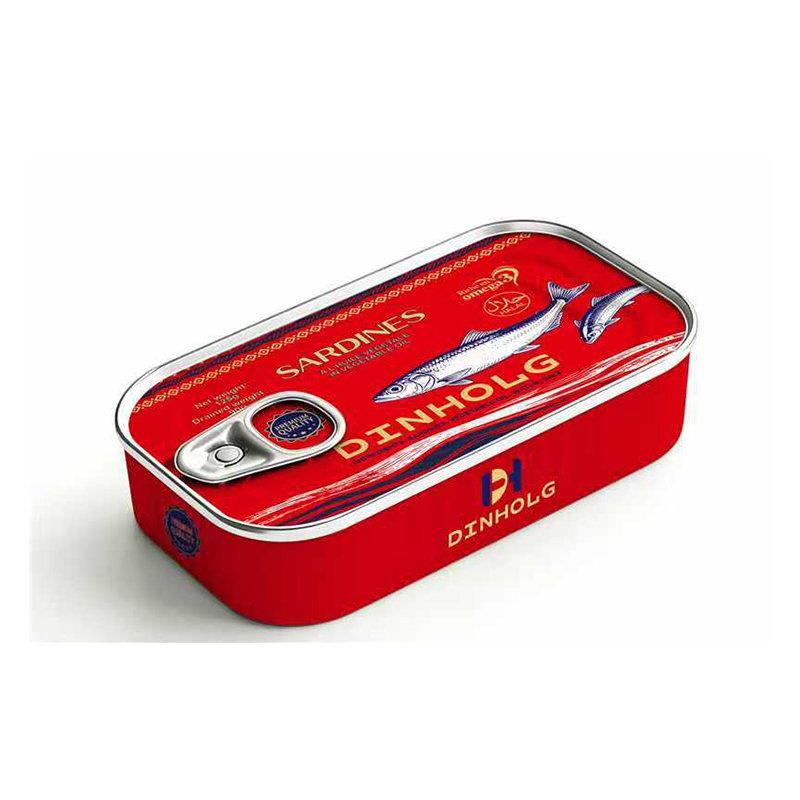
Canned sardines can be developed with customized branding and packaging for different export markets.
Why Launch a Private Label Canned Seafood Brand?
Private label gives importers and distributors greater control over how a seafood product is positioned in the market. Instead of competing only on the price of a generic canned fish product, a buyer can build a recognizable brand around packaging, flavor, quality positioning, and distribution.
There are several reasons why canned sardines are attractive for private label development:
- Long shelf life: Properly processed canned seafood can be distributed without the continuous frozen cold chain required by frozen fish.
- Easy logistics: Shelf-stable canned products can simplify warehousing and international distribution.
- Multiple market segments: Canned sardines can serve supermarkets, wholesalers, convenience stores, catering businesses, and food service distributors.
- Flexible positioning: Brands can develop different flavors, sizes, packaging formats, and price levels.
- Brand ownership: Importers can build long-term consumer recognition instead of relying exclusively on a manufacturer's brand.
For a new seafood brand, the combination of a familiar product category and customizable packaging can provide a relatively straightforward route into retail and wholesale channels.
What Can You Customize With OEM Canned Sardines?
A successful private label project starts by defining exactly what should be customized. The more clearly the buyer communicates these requirements, the easier it is for the manufacturer to provide an accurate quotation and production plan.
- Can size: Common retail formats can be selected according to local consumer demand and distribution channels.
- Fish specification: Buyers can discuss raw material requirements, fish size, preparation style, and filling specifications.
- Cooking medium: Vegetable oil, tomato sauce, brine, spicy sauce, and other market-specific formulations can be considered.
- Flavor profile: Sauce intensity, seasoning, salt level, and local taste preferences can influence the final formulation.
- Can artwork: Brand logo, colors, product information, nutrition information, and market-specific labeling can be incorporated into the packaging.
- Lid style: Depending on the product specification, buyers may choose between easy-open and conventional lid formats.
- Outer cartons: Carton design and case configuration can be developed for wholesale distribution.
For example, DINHOLG's 125g canned sardines can be customized in areas such as labels, outer cartons, and oil or sauce formulation. The product is also available in different flavor directions, including vegetable oil, tomato sauce, and spicy options.
How to Choose the Right Canned Sardine Product Specification
Choosing a can size or flavor should not be based only on what is available from the factory. The specification should match your sales channel and target market.
For supermarkets and convenience stores, smaller consumer-friendly formats can make sense because they are easier to merchandise and price. For food service, catering, and wholesale customers, larger formats may provide better value per serving and reduce packaging costs.
Flavor is equally important. Vegetable oil provides a relatively neutral option for everyday consumption and cooking. Tomato sauce can offer a stronger ready-to-eat positioning, while spicy formulations may be attractive in markets where chili-based seafood products are popular.
When building your first SKU, avoid creating too many variations at once. A better approach is to launch one or two core specifications, measure market response, and then expand the range.
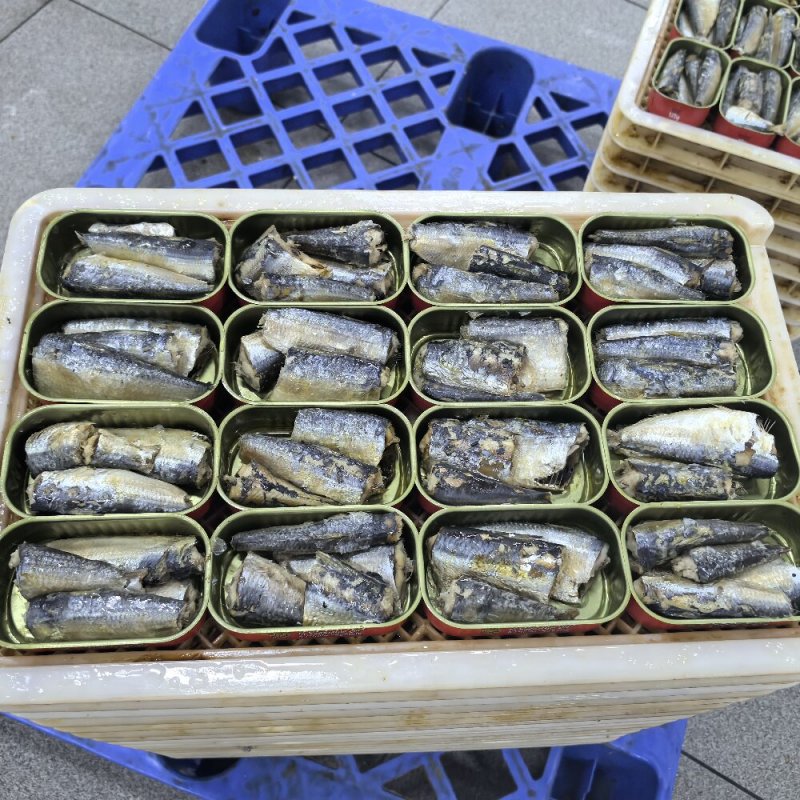
Consistent filling and processing are important for maintaining uniform quality across bulk OEM production.
How Does the OEM Canned Sardine Process Work?
A typical private label canned sardine project follows a structured process from product selection to shipment.
- Define your target market: Identify the destination country, sales channel, consumer price range, and expected annual volume.
- Select the product: Choose the sardine specification, can size, cooking medium, flavor, and packaging format.
- Request samples: Evaluate fish texture, appearance, taste, sauce, can quality, and packaging options before approving production.
- Confirm artwork: Provide the brand logo and packaging design. The manufacturer can then prepare production artwork for approval.
- Confirm specifications and quotation: Agree on product details, packaging, MOQ, pricing, lead time, payment terms, and shipping arrangements.
- Production: The factory processes the seafood, fills the cans, seals them, performs thermal processing, and completes quality checks.
- Inspection and documentation: Product and shipment documentation should be prepared according to the requirements of the destination market.
- Container loading: Finished cartons are loaded for international transportation according to the agreed shipping terms.
This workflow is especially useful for importers who want to turn an existing seafood distribution business into a proprietary brand without investing in their own canning infrastructure.
What Should Buyers Check in an OEM Canned Sardine Factory?
- Does the manufacturer have stable access to sardine raw materials?
- Can the factory support your expected monthly or annual volume?
- Does it offer actual OEM and private label production rather than simple trading?
- Can the supplier customize packaging and flavor specifications?
- Can it provide samples before bulk production?
- Does the factory operate under an established food safety management system?
- Can the supplier provide appropriate export and compliance documentation?
- Are MOQ and lead time realistic for your first market launch?
- Can the supplier maintain consistent quality between repeat orders?
- Does the supplier understand international container shipping and export procedures?
These questions are more important than simply comparing the lowest unit price. A slightly lower quotation does not necessarily create the lowest landed cost if inconsistent quality, delayed production, or packaging problems cause additional expenses.
Why Raw Material Supply Matters for Private Label Sardines
Raw material availability is one of the most important factors behind stable canned seafood production. A private label brand needs consistent taste, appearance, specification, and delivery timing. If a supplier depends entirely on short-term spot purchasing, production can become more difficult during seasonal fluctuations.
DINHOLG states that its supply chain includes stable raw material sources and professional cold storage, with a 3–6 month safety inventory for key raw materials such as sardines and other pelagic fish. This type of supply planning can be particularly valuable for importers managing recurring container orders or annual distribution programs.
For a growing brand, supplier capacity should therefore be evaluated alongside product quality. The ideal OEM partner should be capable of supporting both the first trial container and larger repeat orders as the brand grows.
How Packaging Influences Your Canned Seafood Brand
Packaging is one of the most visible elements of a private label seafood product. Consumers may compare several canned sardine brands side by side, making the can design an important part of product positioning.
A strong design should make the brand name easy to recognize while clearly communicating the fish type, flavor, net weight, nutritional information, ingredients, and other required information. Buyers should also consider whether the packaging needs to be optimized for supermarket shelves, wholesale cartons, convenience stores, or food service distribution.
For export products, packaging should be developed with the destination market's labeling and regulatory requirements in mind. It is important to confirm mandatory information with the manufacturer and relevant local compliance professionals before printing large quantities of packaging.
Can You Build a Canned Seafood Brand Beyond Sardines?
Yes. Sardines can be used as the core product of a broader canned seafood portfolio. Once a brand establishes distribution and customer recognition, additional products can be introduced to increase shelf presence and average order value.
For example, canned mackerel can complement a sardine range by offering a different fish type, package size, flavor profile, and price point. DINHOLG currently offers canned mackerel in tomato sauce with OEM and private label customization options.
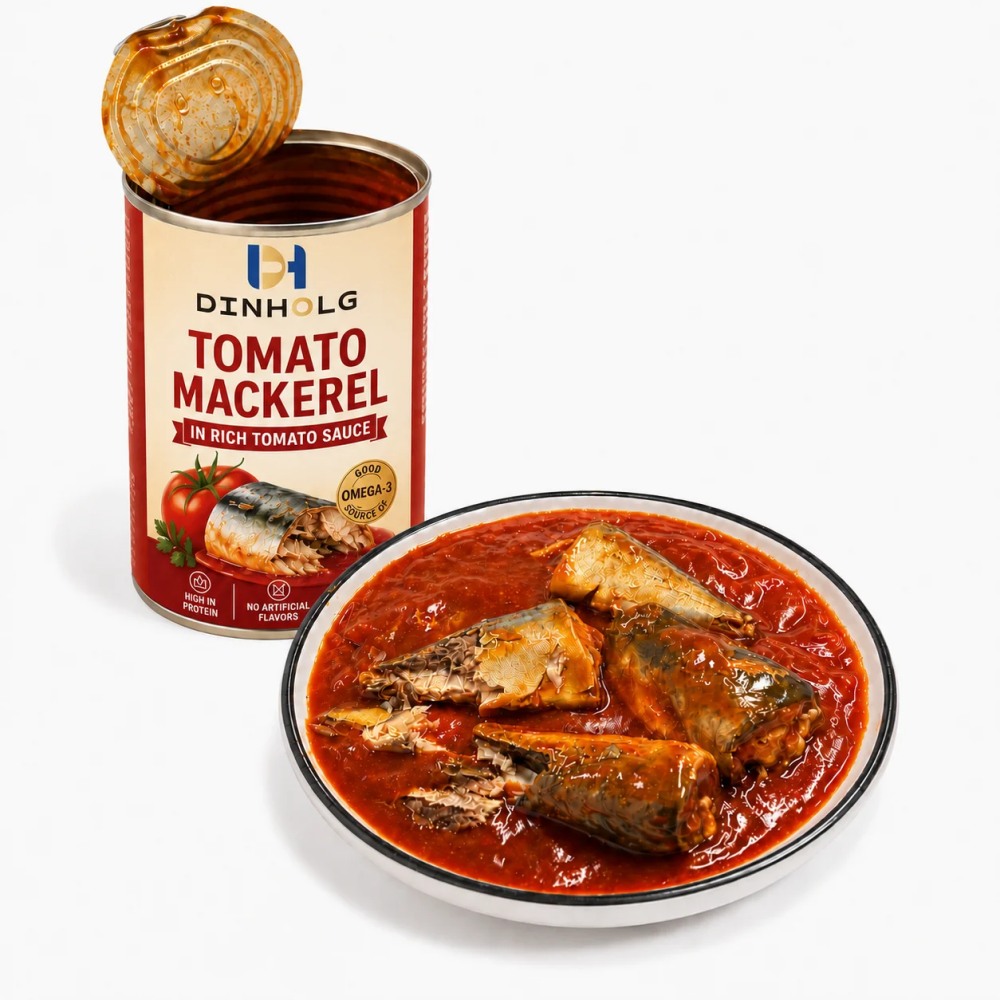
Canned mackerel can be introduced as a complementary SKU when expanding a private label seafood portfolio.
A broader product strategy could eventually include canned sardines, canned mackerel, and other seafood products. This approach allows importers to create a more complete seafood brand rather than depending on a single SKU.
How Much Should You Order for a Private Label Launch?
MOQ is one of the first commercial questions a new brand should clarify with an OEM supplier. The correct order quantity depends on the target market, expected sales velocity, storage capacity, and available working capital.
DINHOLG's standard 125g canned sardine specification lists a minimum order of one 20-foot FCL, with packaging and loading quantities depending on the selected configuration. The company also states that trial samples are available for quality and taste evaluation before formal bulk orders.
For a new brand, the objective should not simply be to order the largest possible volume. Instead, calculate your expected monthly sales, distributor coverage, warehouse capacity, and replenishment cycle. A manageable first shipment can provide market data while limiting inventory risk.
What Certifications and Quality Controls Should Buyers Ask For?
Food safety should be treated as a core purchasing requirement rather than a marketing feature. Buyers should ask the manufacturer which food safety systems and certificates apply to the specific factory and product being purchased.
DINHOLG's published canned sardine specifications reference HACCP, ISO22000, EU food safety requirements, and Halal certification. Its manufacturing information also describes batch testing, microbiological controls, net-weight checks, and thermal canning processes.
However, certification requirements can differ between destination countries. Before placing an order, buyers should confirm the exact documents, labeling requirements, import permits, testing requirements, and product registration rules applicable to their market.
OEM vs. Private Label: Which Model Is Better?
The terms OEM and private label are often used together, but buyers should understand the commercial difference.
- Private label: You sell a manufacturer's product under your own brand, usually with customized packaging and selected specifications.
- OEM: The manufacturer produces according to your defined product and packaging requirements, which can involve a higher level of customization.
- ODM: The manufacturer may provide an existing product concept that can then be adapted for your brand and market.
For most seafood importers launching a new brand, private label is often the simplest starting point. Once the brand has established sales volume, deeper OEM customization can be introduced to create stronger product differentiation.
How to Launch Your Own Canned Sardine Brand Step by Step
A practical launch plan can be summarized into eight steps:
- Define your target country and customer segment.
- Choose your initial sardine size and flavor.
- Find an OEM manufacturer with stable production capacity.
- Request samples and evaluate product quality.
- Develop your brand artwork and packaging.
- Confirm MOQ, pricing, certifications, lead time, and shipping terms.
- Approve the final sample and begin bulk production.
- Launch through distributors, wholesalers, supermarkets, or food service channels and use sales data to expand your SKU range.
What Makes a Good Private Label Canned Seafood Partner?
The best OEM partner is not necessarily the supplier offering the lowest initial quotation. For long-term brand development, buyers should look for a combination of stable raw material supply, consistent manufacturing quality, flexible customization, export experience, transparent communication, and reliable logistics.
A manufacturer that can support product development, packaging, quality control, documentation, and container shipping can reduce the number of suppliers involved in your launch. This simplifies procurement and makes it easier to scale the brand when demand increases.
Ready to develop your own canned seafood brand?
Start with one clearly defined canned sardine specification, request samples, confirm the packaging requirements, and discuss your target market with an experienced OEM supplier. DINHOLG supports bulk canned seafood procurement, OEM/ODM customization, private label packaging, and international export solutions for global buyers.
Whether you are a seafood importer, wholesaler, supermarket supplier, or food distributor, a well-planned private label program can turn a standard canned sardine product into a long-term branded business.
- The Value of a Professional Seafood Processing Factory in Bulk Seafood Supply Chains
- Frozen Whole Tilapia Fish Size Guide: Choosing the Right Weight for Wholesale Markets
- Frozen Whole Tilapia vs. Tilapia Fillets: Which Is Better for Wholesale Distribution?
- OEM & Private Label Canned Sardines: How to Launch Your Own Canned Seafood Brand
- Frozen Tilapia Buying Guide: What to Check
- How to Source Frozen Tilapia from Reliable Seafood Exporters